czwartek, 31 lipca 2008

Intel, Portugal kick off educational initiative

As part of its comprehensive educational technology program, Portuguese Prime Minister José Sócrates and Intel Chairman Craig Barrett announced today the country will provide half a million Intel Corp classmate PCs to school children in the country under its new Magellan Initiative (Iniciativa Magalhães).
For more EDN coverage of Intel's classmate PC, see:
Future Intel Classmate PCs to be based on AtomIntel readies global push for Classmate PCIntel resigns One Laptop Per Child in favor of its own Classmate PC programIntel's quad core coming in NovemberThe program, launched today, aims to deliver the full-featured student laptops especially developed by Intel for education, and complements Portugal’s year-old e-School (“e-Escola”) project, which provides educational notebooks and Internet access to teachers and students for the secondary level of school education.
Both programs align with the government’s “Technology Plan – Portugal” (Plano Tecnológico – Portugal), which is meant to increase the use of computers and the Internet in order to bring to Portuguese citizens the latest technology and support them to participate in a knowledge-based economy.
“We enthusiastically support Portugal’s commitment to a comprehensive technological plan for education. The government’s priority to make technology accessible to Portugal’s schools and children is a model for governments and corporations working together to prepare future generations for long-term opportunities” Barrett said in a statement, who is traveling to Portugal on behalf of Intel and is also the chairman of United Nations Global Alliance for ICT and Development (UN GAID).
Portugal Prime Minister Sócrates commented, “This new collaboration with Intel underscores Portugal’s commitment to advance quickly toward a knowledge-based economy. By equipping our schools with state-of-the-art computing technology and Internet connectivity, we hope to hasten the transition to economic models that benefit our citizens.”
Intel said it will provide technology advice and support to the Portuguese government in the management, promotion and implementation of the e-Escola and Magellan initiatives, and said it will create a “Competence Centre” in Portugal to expand the use of mobile PCs and Internet access and use that knowledge to replicate pilot projects in other countries.
Prior to today’s launch, Intel noted that Barrett met with Sócrates to discuss the prime minister’s plan to invest in the education for Portuguese students and to provide them with tools to participate in the 21st century economy with key priorities including education, foreign investment, creating favorable conditions for entrepreneurs, and promoting growth and jobs.

niedziela, 1 czerwca 2008

SEC investigates insider trading scheme concerning Freescale, ATI


The Securities and Exchange Commission (SEC) has charged a former partner at Ernst & Young LLP and two others in an alleged insider trading scheme concerning Freescale Semiconductor Inc and ATI Technologies Inc.
According to the
SEC complaint filed Thursday, James E Gansman, a former partner in Ernst & Young's transaction advisory services department, from approximately summer 2006 through fall 2007 tipped his friend Donna Murdoch about the identities of at least seven different acquisition targets of clients who sought valuation services from his firm.
Among those seven targets were Freescale and ATI.
Freescale became the largest leveraged buy-out (LBO) in the history of the technology industry with a $17.6 billion price tag in December 2006, when the chip maker was acquired by private equity firms. July of that same year, Advanced Micro Devices announced plans to buy graphics chip maker ATI for approximately $5.4 billion.
The SEC complaint further charges that Murdoch used the non-public information to trade in the securities of the target companies; to tip her father, who also traded; and to make recommendations to two others, who traded, as well.
The SEC estimates that the activity resulted in nearly $600,000 in illicit profits.
"This case underscores how important it is for deal advisers and due diligence providers retained by acquirers and their targets to respect the confidentiality of the information shared with them," said Linda Chatman Thomsen, director of the SEC's division of enforcement, in a statement.
Ernst & Young did not return calls to Electronic News for comment.
According to the SEC's complaint, Gansman misappropriated the information about pending acquisitions on numerous occasions in breach of a duty of confidentiality owed to Ernst & Young and its clients. Murdoch was a registered securities professional and managing director of a Philadelphia-based broker-dealer and investment banking firm during the alleged period of insider trading. The complaint claims that she used the non-public information provided by Gansman to tip her father, Gerald L Brodsky, who also is named as a defendant by the SEC, and to make recommendations to two others.
According to the complaint, Murdoch’s trading based on the non-public information from Gansman resulting in at least $392,035 in illegal profits. The SEC claims that she provided information about one of the pending acquisitions, Freescale, to Brodsky, who traded on this information through a nominee account. Brodsky’s illegal profits totaled $63,400, the SEC estimated. The complaint further alleges that Murdoch recommended trading in the securities of two of the target companies, Freescale and ATI, to other individuals who traded for profits of $140,760.
The SEC complaint asserts that Gansman, Murdoch, and Brodsky violated Section 10(b) of the
Securities Exchange Act of 1934 and Rule 10b-5 thereunder, and that defendants Gansman and Murdoch also violated Section 14(e) of the Exchange Act and Rule 14e-3 thereunder.
The SEC said it is seeking injunctions against future violations of the federal securities laws, disgorgement of unlawful trading profits with prejudgment interest, and civil monetary penalties. The SEC reminded that the investigation in its allegations is ongoing
.

wtorek, 13 maja 2008

AMD creates central engineering organization

Following last month's resignation of its CTO Phil Hester, microprocessor challenger Advanced Micro Devices [AMD] has promoted Randy Allen to head its computing solutions group, forming a central engineering organization, to be co-led by veteran engineering executives Chekib Akrout and Jeff VerHeul.
The appointments come as the Sunnyvale, Calif.-based company re-architects its business for sustained profitability due to the departure of Mario Rivas, formerly executive VP of the computing solutions group who has left AMD to pursue new opportunities.
“We are accelerating AMD’s transformation, reshaping the organization and bolstering our management team to lead in our x86 microprocessor and graphics businesses. Placing experienced leaders in new, more focused roles will enhance our execution and progress towards sustained profitability and long-term success. The creation of a centralized engineering organization aligns and focuses AMD’s world-class engineers and intellectual property portfolio on the strong business opportunities in front of us,” explained AMD president and COO Dirk Meyer, in a statement.
In his new role as senior VP of AMD’s computing solutions group, Allen reports to Meyer and is responsible for the development and management of AMD’s broad and growing portfolio of consumer and commercial microprocessor solutions and platforms.
Allen, a 24-year AMD veteran was most recently responsible for the company’s server and workstation business and previously oversaw microprocessor engineering for the company, including the Opteron and Athlon 64 processors.
The newly formed central engineering organization will be co-led by Chekib Akrout, who is joining AMD from Freescale Semiconductor, and Jeff VerHeul, corporate VP of design engineering at AMD, and is tasked with directing the development and execution of AMD’s technology and product roadmaps in partnership with AMD’s business units, reporting to Dirk Meyer.
Akrout joins AMD after serving as VP of design technology at Freescale, prior to which he worked at IBM, managed the development of a wide range of products including microprocessors, ASICs and mixed signal devices, and was responsible for IBM’s work on the development of the Cell processor, the Xbox 360 processor for Microsoft, and embedded PowerPC cores.
VerHeul joined AMD in August 2005 after a 25 year career with IBM.
AMD also promoted Allen Sockwell to senior VP of human resources and chief talent officer responsible for developing AMD's leadership assets and employee talent, due to the departure of Michel Cadieux, formerly senior VP and chief talent officer.
In other AMD news, the company rolled out what it says are the industry’s first energy-efficient x86 server processors with four processing cores and an integrated memory controller in a 55-watt ACP thermal envelope, aimed at blade and rack system applications.
AMD said the quad-core Opteron HE processors were designed to help datacenter managers who see power consumption and virtualization as the keys to solving their overall performance equation.
As such, the processors contain AMD’s advanced power management and virtualization innovations for power-conscious datacenter managers.
Quad-core AMD Opteron HE processors are available in both the 2300 and 8300 Series for two-, four- and eight-way rack servers and blades.

sobota, 26 kwietnia 2008

Samsung, Sony to invest $1.8B on LCD line


Reaffirming their liquid crystal display (LCD) panel manufacturing alliance, Samsung and Sony have plans to jointly construct a third flat-screen factory in South Korea, according to filings with the Korea Stock Exchange.
The companies are planning to invest $1.8 billion (1.8 trillion Korean won) on an eighth-generation (8G) production line through their S-LCD joint venture that already operates two factories in Tangjeong in South Korea. The new factory will be built at the same site and is scheduled to start turning out LCD panels in the second quarter of 2009, the two companies said in reports.
In November 2006,
S-LCD completed its second line called 8-1, which is also 8G.The new line has been given the name 8-2, and will accept sheets of mother glass-- from which several panels can be made-- measuring 220 centimeters by 250 centimeters.
In addition to its other eighth-generation line in Tangjeong, called line 8-1, S-LCD operates its original seventh-generation (7G) line. With each successive jump in production technology the size of the mother glass sheets is increased and economies are introduced into the production process, with the higher technology lines making larger panels at a lower per-inch cost.
The 8-2 factory is scheduled to process 60,000 mother glass sheets per month, which makes it larger than the 8-1 facility that handles up to 50,000 sheets per month, reports said.
Output from the plant will be split between the companies, with 51% going to Samsung and 49% going to Sony, in line with their share holdings in S-LCD.
In February,
Sony had started talks with Sharp towards investing in a new production line that Sharp has under construction in Japan, which will be based on tenth generation technology and will be best suited to making LCD panels in the 60- and 50-inch class

sobota, 5 kwietnia 2008

Motorola layoffs reach 10,000 mark


Motorola Inc in a filing with Securities and Exchange Commission (SEC) Thursday stated plans to cut 2,600 jobs, bringing the total number of employees laid off at the company to about 10,000 since the beginning of 2007.
Motorola, which last week announced it would
spin off its struggling mobile devices business in an attempt to create shareholder value, is doing so as part of an announced $500 million cost savings plan.
The move follows on announcements from Motorola in January 2007 that it would slash
3,500 jobs and in May 2007 that it would cut an additional 4,000 jobs as it attempted to improve its ailing financial results.
Share your comments on Motorola’s layoffs in our related blog, “
Job cuts begin at Motorola as it separates mobile devices.”As a result of the 2,600 job cuts, Motorola said in the SEC filing that it will take a pre-tax charge of $104 million in Q1. About $113 million of the charge comes from severance costs, partially offset by $9 million of reversals for accruals from prior periods that are no longer needed, the filing states.
In October 2007, Motorola announced that its layoffs had cost the company more than
$300 million so far for the year.
Motorola said that its estimated Q1 charges are expected to result in future cash expenditures during 2008 and that all three of its business segments, as well as various corporate functions, are impacted by the workforce reduction plans.
Included in the 2,600 number are
position cuts in Singapore announced earlier this week. Motorola said it will end manufacturing of mobile devices at its location in Singapore by year’s end, cutting about 700 employees, as it moves forward with plans to separate its mobile devices business.
The workforce reduction represents approximately 4% of Motorola’s 66,000 employee base, as recorded in its 2007 annual report filing, made in February.

środa, 19 marca 2008

Intel, Microsoft establish university-based parallel ...


... computing research centers.


After much anticipation, and making it the first joint industry and university research alliance in the US focused on mainstream parallel computing, technology giants Intel Corp and Microsoft Corp finally announced today their partnership with academia to create two universal parallel computing research centers (UPCRC), meant to accelerate what they said are developments in mainstream parallel computing for consumers and businesses in desktop and mobile computing.
With research to focus on advancing parallel programming applications, architecture and operating systems software, the centers will be set up at the University of California, Berkeley (UC Berkeley), and the University of Illinois at Urbana-Champaign (UIUC), with the companies committing a combined $20 million to the centers over the next 5 years.
An additional $8 million will come from UIUC, and UC Berkeley is said to have applied for $7 million in funds from a state-supported program to match industry grants, the companies noted.
Parallel computing leverages advanced software and processors with multiple cores or engines, which, when combined can handle multiple instructions and tasks simultaneously, and has become essential to enhancing program performance and satisfying the increased demands for power efficiency and small form factors, the companies reminded.
The technology industry is now challenged to bring the benefits of multicore processing (based on tens or hundreds of cores) to mainstream developers and eventually to consumers with the ultimate goal of making parallel computing easier for developers by providing tools for new platform architectures, operating system architectures, programming methods and tools, and application models.
Intel and Microsoft believe the changes needed impact the entire industry, from consumers to hardware manufacturers and from the entire software development infrastructure to application developers who rely upon it.
Although many companies including Intel and Microsoft have hardware and software today that is capable of handling dual- and quad-core-based PCs, in the coming years computers will surely contain even more processors.
Andrew Chien, VP, corporate technology group and director for
Intel Research explained in a statement, “Intel has already shown an 80-core research processor, and we’re quickly moving the computing industry to a many-core world.”
“Working with Microsoft and these two prestigious universities will help catalyze the long-term breakthroughs that are needed to enable dramatic new applications for the mainstream user,” he continued.
“We think these new applications will have the ability to efficiently and robustly sense and act in our everyday world with new capabilities: rich digital media and visual interfaces, powerful statistical analyses and search, and mobile applications. Ultimately, these sensing and human interface capabilities will bridge the physical world with the virtual,” Chien added.
Further,
Microsoft Research’s Tony Hey, corporate VP of external research said, “Driven by the unprecedented capability of multicore processors, we’re in the midst of a revolution in the computing industry, which profoundly affects the way we develop software. Working jointly with industry and academia, we plan to explore the next generation of hardware and software to unlock the promise and the power of parallel computing and enable a change in the way people use technology.”
As part of the selection process, 25 top-tier institutions in the field of parallel computing research were evaluated, with UC Berkeley and UIUC unanimously selected for their outstanding reputation in computing and their expertise in the specific area of parallel computing among other reasons.
The UPCRC at UC Berkeley will be directed by David Patterson, professor of computer science and pioneering expert in computer architecture, and will include 14 members from the UC Berkeley faculty, as well as 50 doctoral students and postdoctoral researchers.
The UPCRC at the University of Illinois at Urbana-Champaign will be led by Marc Snir, professor of computer science and Wen-Mei Hwu, professor of electrical and computer engineering, in collaboration with 20 additional faculty members and 26 graduate students and researchers.
Software developed by the centers will be made available to the technology community for additional development, the companies asserted.
The parties said the research to be conducted is expected to complement and extend existing parallel computing programs at UC Berkeley, UIUC, Microsoft and Intel, with the centers' research agenda aligning closely with both Intel’s tera-scale computing research program and Microsoft's technical computing initiative

środa, 13 lutego 2008

Security engineering

Security engineering is the field of engineering dealing with the security and integrity of real-world systems.
It is similar to systems engineering in that its motivation is to make a system meet requirements, but with the added dimension of enforcing a security policy.
It has existed as an informal field for centuries, in the fields of locksmithing and security printing. Technological advances, principally in the field of computers, have now allowed the creation of far more complex systems, with new and complex security problems.
Because modern systems cut across many areas of human endeavor, security engineers not only need consider the mathematical and physical properties of systems; they also need to consider attacks on the people who use and form parts of those systems using social engineering attacks.
Secure systems have to resist not only technical attacks, but also coercion, fraud, and deception by confidence tricksters. For this reason it involves aspects of social science, psychology and economics, as well as physics, chemistry and mathematics.
Some of the techniques used, such as fault tree analysis, are derived from safety engineering..

wtorek, 1 stycznia 2008

Mezzanine card captures precise analog data


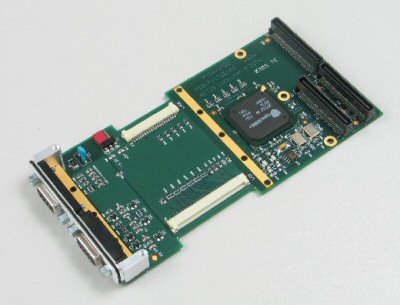
MEN Micro’s recently unveiled M36N analog-input mezzanine board comes in an M-module form factor and features high-resolution data acquisition for the myriad analog signals designs encounter in industrial automation, measuring, and simulation applications. You can use the M36N, available in 16- or 18-bit versions, as an I/O extension for CompactPCI, PCI, PXI, or VME embedded systems as well as on stand-alone single-board computers. The module provides as many as 16 single-pole grounded channels for voltage or current or eight channels for differential voltage or current. You can separately adjust each channel and input range for data-acquisition requirements.
The board's 16-bit resolution provides an accuracy of at least 0.05% over the entire −40 to +85°C temperature range. A fast ADC and autoincrementing multiplexer channel enable a total 16-bit acquisition time of 130 μsec. An
Altera Cyclone II FPGA on the M36N controls signal conditioning and offers space for application-specific function extensions. You can implement the included Altera Nios II Softcore processor in the FPGA for intelligent pre-data-processing, noise-shaping, or additional functions. The price for the M36N starts at $850, and delivery time is six weeks.